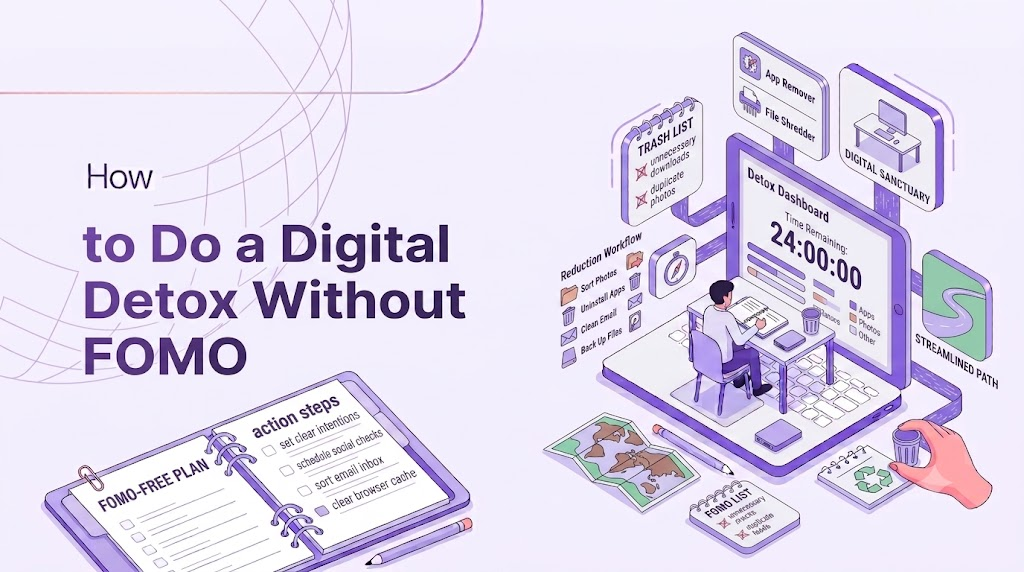
The fear of missing out is the number one reason digital detoxes fail. You put your phone away for an afternoon, and by hour two you’re convinced something urgent is happening without you — a text, a work email, a group chat decision. The trick isn’t to ignore that fear. It’s to plan around it so it never gets the chance to build.
Tell People Before You Disappear
Most FOMO comes from uncertainty, not from actually missing something. A short message to close friends, family, or your team — “I’m offline this weekend, back Monday” — removes the guesswork. People stop expecting instant replies, and you stop worrying that silence looks like you’ve vanished.
Set an Auto-Reply
For work or anything time-sensitive, an out-of-office or auto-reply message does the heavy lifting for you. It reassures the sender their message was received and tells them when to expect a response. This one step removes a huge amount of low-level anxiety about “what if someone needs me.”
Pick a Detox Length You’ll Actually Finish
FOMO gets worse the longer and vaguer the detox is. “No phone for a week” invites anxiety; “no phone from 6pm Friday to 6pm Saturday” is concrete and finishable. Start with a short, clearly bounded window. Success at a small scale builds the confidence to go longer next time.
Give Yourself a Re-Entry Ritual
Part of FOMO is dreading the pile-up you’ll face when you return. Decide in advance how you’ll catch up — for example, checking messages before email, or giving yourself 20 uninterrupted minutes to scroll through everything before responding to anything. Knowing you have a plan for re-entry makes the time away feel safer.
Remember What You’re Not Missing
Ironically, most of what circulates on social media during a detox window isn’t something you’d have engaged with anyway — recycled headlines, arguments in comment sections, content designed to be forgotten within a day. Reminding yourself of this before you unplug helps reframe “missing out” as “opting out of noise.”
Focus on What You’re Gaining
Reframe the detox around what you’re doing instead, not what you’re avoiding. A walk, an uninterrupted conversation, a finished chapter of a book — these are real, felt experiences that compete favorably with the vague anxiety of “what if I missed something.” The more present you are in the offline moment, the less bandwidth FOMO has to work with.
Accept That You Might Miss Something Small — and That’s Fine
Realistically, you might miss a meme, a minor update, or a joke in a group chat. Naming that possibility out loud, and accepting it as an acceptable cost, takes away its power. The things that truly matter — emergencies, important news — will almost always reach you through a call, not a feed.
A digital detox doesn’t require willpower alone. It requires removing the uncertainty that FOMO feeds on, so your mind has nothing left to spin around while you’re away from your screen.